

There is a cat in an American house right now who is fourteen years old. She sleeps on the bed. She eats twice a day from a bowl in the kitchen, in the same room where the family eats. She has been to a veterinarian twice in her life.
Households like hers are not rare. CATalyst Council estimates that roughly 51 million American cats saw no veterinarian at all last year, not even for a basic exam. Nor is hers an indifferent household. Shannon Landry of Packaged Facts, presenting at the NASC annual conference in Phoenix this spring, put the figures at 91% of cat owners considering the cat part of the family, 81% keeping her in the family eating or living area, and 56% sharing a bed with her.
Fourteen years of twice-daily feeding comes to something on the order of ten thousand meals. Against two clinical encounters.
That ratio is the commercial problem in companion animal innovation and the demographics are turning it into the defining one.
The Growth is Feline and the Contraction is Canine
Two numbers in the same report have moved in opposite directions for four years. In the forecast CATalyst Council published this summer with Vetsource, Kynetec and Dedekind Cut Labs, puppy visits sit roughly 38% below their 2018/19 baseline. Kitten visits have held 8% to 10% above it.
The puppy half of that is already locked in, because cohort size largely determines an animal’s visits for the rest of its life. Four consecutive below-baseline puppy cohorts are already in the demographics. The authors put combined clinical visit growth between negative 2% and zero through 2031, against the 2% to 3% recovery the industry has been expecting.
Households tell the same story. Landry, working from a January survey of roughly 1,500 owners alongside MRI Simmons data covering some 50,000 households, reported that cat-owning households tracked overall US household growth between 2019 and 2025 while dog-owning households declined. Kitten households, about 66% of puppy households in 2019, reached 99% by 2025. The causes she gave are structural: older owners aging out of dog ownership, younger owners facing housing costs that make a dog impractical, and renters skewing heavily toward cats.
But the Clinical Channel Cannot Carry It
Then the number that complicates all of it. CATalyst Council’s Volume V report, drawing on a survey screening some 60,000 households, estimates that 33% of American household cats received Veterinary care in 2025 against 71% of dogs. A 38 percentage point medicalization gap.
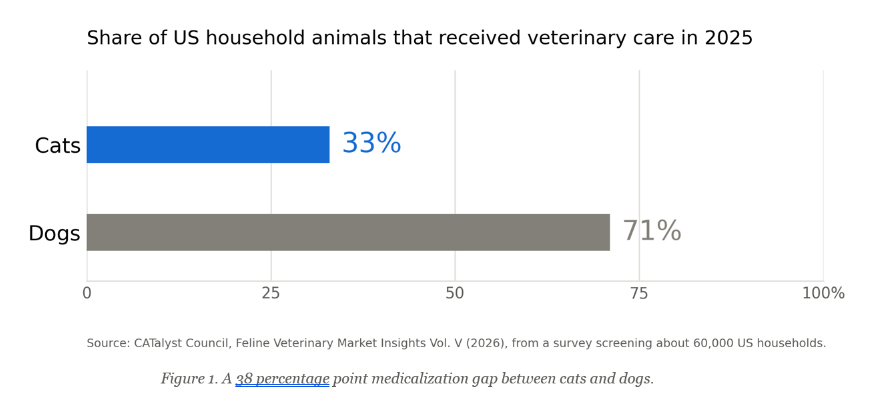
Almost everything animal health knows how to build assumes a clinical touchpoint: a prescriber to write it, a practice to stock it, a visit at which the conversation happens. That machinery is aimed at the species in contraction. The species in growth uses it at less than half the rate. So any intervention that requires a prescriber meets its ceiling early in cats and the ceiling has nothing to do with whether the intervention works. A product reaching a third of a population is a good product with a distribution problem.
CATalyst reads its own data as a case for closing that gap, and the case is strong. Feline practice revenue came in at $12.7 billion in 2025 against $33.9 billion at parity with dogs, an unclaimed $21 billion. My own view is that this is a decade of work. Closing 38 points of medicalization means changing what tens of millions of households do and a company deciding what to build this year has to plan against the population as it behaves today.
The Category That Should Be Easiest is Not Acting Like It
That points at food, additives, treats and supplements, which reach the owner where the owner already is: on the shelf, in the basket, on autoship, with no gatekeeper and a purchase cycle measured in weeks. The scale is there. Of roughly $156 billion in U.S. pet product and service sales, Landry put cats at about $46 billion against $104 billion for dogs, and in food and treats specifically, $22 billion against $46 billion. Population explains some of that, and the sources do not break spend out per animal. What is not in doubt is where the gap sits: the one category with daily access to both species.
Supplements should be the fastest route in. No gatekeeper, low barrier to entry, direct sale to the owner, and Packaged Facts projects cat product sales growing faster than dog across most categories over the next five years. In practice, Landry reported that about 20% of cat owners buy any supplement, and among those who do, the strongest single influence on the purchase is the veterinarian.
Influence is not the same as gating and the difference matters commercially. A recommendation made once, at one of the visits that does happen, can carry an autoship for years without the veterinarian touching another transaction. But a category that needs no gatekeeper appears to be recruiting its buyers largely through the one professional two thirds of these animals did not see last year, and a 20% ceiling is consistent with that. The constraint looks inherited rather than intrinsic.
The channels that would fix it are sitting underused. Landry noted that supplements lag pet food in direct-to-consumer purchasing and described autoship, which amounts to guaranteed repeat sales, as an underdeveloped channel. Format compounds it. Cats are obligate carnivores with unforgiving palatability standards, yet the dominant supplement format remains the soft chew, built around canine preferences. A product line built on canine assumptions does not transfer to cats by reducing the dose.
Owners have noticed. Asked whether cats are treated as second-class citizens, a growing share of cat owners agree, and Landry reported that sentiment worsening across successive survey waves.
The Sentence Nobody Can Print
One more constraint, and it sits on the label.
A cat food can talk about nutrition, palatability and body condition. What no bag or bottle may say is that the product will extend the animal’s life. Intended use is decisive under section 201(g), and the Seventh Circuit has read food as articles used primarily for taste, aroma, or nutritive value. Say more than that and the product stops being food and becomes an unapproved animal drug.
The line is being redrawn, though not in this direction. FDA withdrew its 1998 policy on animal foods with drug claims in May 2024, said it no longer reflected the agency’s thinking, invited firms to make contact early, and said it intends to issue replacement guidance, which has not appeared. The notice is worth reading for what prompted it: a congressional request that FDA find solutions for how ingredient claims for animal production, animal well-being, food safety and the environment could be regulated as animal food.
The bill the industry is watching runs the same way. It would create a pathway for zootechnical substances, defined as acting only within the animal’s gastrointestinal tract, for the purposes of digestion byproducts, foodborne pathogen reduction or gut microbiome effects, with disease treatment and prevention expressly excluded and a disclaimer to that effect required on the label. Both chambers introduced it in 2025 and both versions remain in committee.
Read that definition against Landry’s finding that probiotics are already among the top conditions driving feline supplement purchase. A feline gut product might well fit the pathway. What it could not do is say anything about healthy aging, because healthy aging is not one of the three permitted purposes. Both routes point the same way. The purposes named in the request to FDA were production, well-being, food safety and the environment; the purposes named in the bill are byproducts, pathogens and the biome. The road is being paved through exactly the ingredient class cat owners are already buying, and the interesting part of the story is struck out before the product ships.
Europe is often held up as the permissive alternative, and in one respect, it is. Its list of particular nutritional purposes lets a feed name a clinical condition on the label, and cats appear on it repeatedly: chronic renal insufficiency, diabetes mellitus, chronic cardiac insufficiency, chronic liver insufficiency. What those entries have in common is that each names a disease. And entry after entry carries a required labeling line recommending that a veterinarian’s opinion be sought before use, so the permissive route runs back through the same professional.
Where That Leaves Us
The species is growing while the clinical channel that this industry was built around reaches a third of it. The route with daily access exists, and it is underbuilt, sold in canine formats, recruited through a professional most of these animals rarely see, and constrained at the label from describing much of what it does.
Two questions matter more here than any forecast. What does a product designed around feline palatability and an owner’s daily routine actually look like, as distinct from a smaller version of the canine one. And whether the Veterinary relationship can be kept as a credibility signal without being relied on as the distribution channel.
I would start with the second, because the answer determines what the first is worth.
The cat on the bed has a few years left in her, several thousand more meals, and on current form no appointments. Cats are where this industry grows next, and that much is out of the bag. What is still in it is the thing that reaches them twice a day.
SOURCES: Shannon Landry, Packaged Facts Pet, 2026 NASC Annual Conference, Phoenix, drawing on a January to February 2026 survey of approximately 1,500 pet owners and MRI Simmons household data. CATalyst Council, Feline Veterinary Market Insights: Volume V, February 2026. CATalyst Council with Vetsource, Kynetec and Dedekind Cut Labs, Puppocalypse, Kitten Craze, and the Expectations Reset, second edition, July 2026. FD&C Act 201(g); Nutrilab v. Schweiker, 713 F.2d 335 (7th Cir. 1983). FDA withdrawal of PPM 1240.3605, 89 FR 43857 (20 May 2024), Docket FDA-2022-N-2015, and FDA Letter to Industry on novel animal foods with drug claims. Innovative FEED Act of 2025, H.R. 2203 and S. 1906. Commission Regulation (EU) 2020/354.