
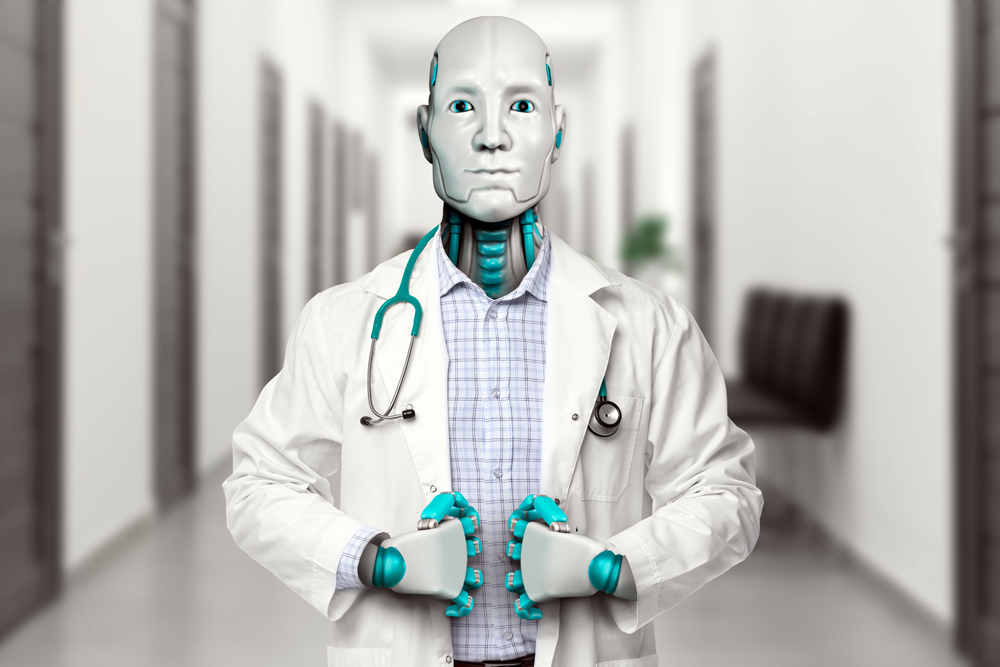
Veterinarians should position themselves as expert interpreters of information who integrate scientific evidence with patient-specific clinical judgment.”
“The veterinarian must become the information steward.”
This morning, I started my day catching up on the news. Prominently highlighted was the new Nancy Grace Roman Space Telescope that will serve as NASA’s next major space observatory. With a $4 billion budget, this extraordinary telescope with allow us to explore a galaxy and universe we barely understand by investigating dark energy, exoplanets, and infrared astrophysics. Set to launch on August 30, the telescope is expected to send back 1.4 terabytes of data every day totaling 20,000 terabytes over its five-year mission. AI is critical for the massive data streams, sifting through data to identify hidden planets, black holes, and other new discoveries. This is happening today.
Back to earth, where my thoughts immediately went to the vast opportunities for AI in Veterinary medicine. We earthlings are using AI in many corners of our daily lives. A 2025 PEW report indicated that 95% of adults say they have heard a little about AI. The number saying they have heard a lot has increased from 26% in 2022 to 47% in 2025. A large majority (73%) say they would be willing to let AI assist them a little in their day-to-day activities.
The Harris Poll indicates that 62% of U.S. adults use AI for medical and health information. Gallup News estimated that 14 million U.S. adults have skipped a traditional doctor’s visit after receiving guidance from an AI chatbot. These trends are transferring to animal owners as they use AI tools to seek medical advice for their animals.
The Punchline
Veterinarians today are practicing in a fundamentally different information environment than they did even five years ago. Animal owners no longer arrive with only observations and questions. Increasingly, they arrive with pages of internet searches, social media posts, chatbot conversations, AI-generated treatment plans, and even differential diagnoses generated before they walk through the clinic door.
Some Veterinary professionals view this trend with frustration. Others see it as a threat to their expertise. Neither response is likely to serve the profession or patients well. The reality is that artificial intelligence is not going away. The question is no longer whether clients will use AI. The question is how veterinarians can transform AI-informed clients into better partners in patient care. Rather than competing with AI, veterinarians should position themselves as expert interpreters of information who integrate scientific evidence with patient-specific clinical judgment.
The Information Revolution Has Entered Veterinary Medicine
Veterinary medicine is entering an era in which information is nearly unlimited, instantaneous, and increasingly generated by artificial intelligence. Clients can now describe their pet’s clinical signs to an AI chatbot and receive a list of possible differential diagnoses, explanations of laboratory results, suggested treatments, and prognostic information within seconds.
This phenomenon mirrors changes already occurring throughout human healthcare. In my own household on a Friday night, my husband noticed a sudden painful red lesion on his side. I took a photo and loaded it into ChatGPT with a description of symptoms. The immediate answer was Shingles. Our family physician confirmed Shingles during his appointment on the following Tuesday.
We are like the millions of patients who now use generative AI systems to interpret symptoms, understand diagnostic tests, prepare questions for physicians, and seek second opinions. Early studies suggest that AI-generated responses are frequently perceived by users as highly empathetic, comprehensive, and trustworthy, sometimes even more so than responses written by clinicians.
For Veterinary medicine, the implications are profound. The question is no longer whether clients will use AI. The question is how veterinarians should respond when they do.
“AI will become as common in healthcare as the stethoscope.” —Dr. Robert Pearl
Information Does Not Equal Clinical Judgment
Artificial intelligence has demonstrated remarkable capabilities in summarizing medical literature, explaining disease processes, organizing complex information, and communicating in language understandable to lay audiences. Nevertheless, these strengths should not be confused with clinical expertise. Veterinary diagnosis depends upon far more than pattern recognition. Clinical decision-making requires integration of:
- Comprehensive patient history
- Physical examination findings
- Diagnostic testing
- Species- and breed-specific considerations
- Behavioral assessment
- Environmental influences
- Financial and logistical constraints
- Client values and goals
- Professional judgment developed through years of education and clinical experience
These elements cannot be fully captured by text prompts alone. Consequently, AI should be viewed as an adjunct to, not a replacement for the veterinarian’s clinical reasoning.
Why Clients Turn to AI
Understanding client motivations is essential. Most owners do not consult AI because they distrust veterinarians. Rather, they seek: (1) immediate answers outside normal business hours; (2) reassurance during periods of uncertainty; (3) education that prepares them for appointments; (4) clarification of unfamiliar terminology; and (5) greater participation in healthcare decisions.
These motivations are consistent with decades of research demonstrating that healthcare consumers increasingly desire active participation in medical decision-making rather than passive receipt of recommendations. AI simply accelerates this long-standing trend toward more informed and engaged clients.
From Gatekeeper to Interpreter
Historically, healthcare professionals served as both the primary source and interpreter of medical information. Today, those roles are diverging. Clients often obtain information independently before entering the examination room. Accordingly, the veterinarian’s value increasingly lies not in exclusive access to information, but in the ability to evaluate its quality, relevance, and applicability to an individual patient. This shift represents an opportunity rather than a threat. The veterinarian becomes the professional who answers critical questions such as:
- Which information is supported by scientific evidence?
- Which recommendations apply to this specific patient?
- Which online claims are outdated or misleading?
- What important considerations are absent?
- How should competing treatment options be prioritized?
Clinical interpretation, not information possession, becomes the defining professional competency.
Avoid Defensive Communication
Veterinarians may understandably become frustrated when clients cite information obtained from AI or social media that conflicts with professional recommendations; however, dismissive responses such as, “Don’t believe everything you read online,” may inadvertently reduce trust and discourage future dialogue. A more effective communication strategy acknowledges the client’s initiative while reaffirming professional expertise; for example, “I’m glad you looked into this. Let’s review together what you found and discuss how it applies to your pet.” Such responses validate client engagement while preserving the veterinarian’s role as the ultimate clinical decision-maker.
Communication research consistently demonstrates that collaborative interactions increase trust, improve adherence, and strengthen professional relationships. Veterinary studies similarly show that clients prefer collaborative decision-making regardless of appointment type and that effective shared decision-making is enhanced through intentional communication by both veterinarians and Veterinary technicians.
The Importance of Shared Decision-Making
Shared decision-making has become a cornerstone of contemporary human healthcare and is gaining increasing recognition within Veterinary medicine. Rather than viewing AI-generated information as competition, veterinarians can use it as the starting point for meaningful discussion. Questions such as those below provide insight into the client’s priorities while strengthening the veterinarian-client relationship:
- “What made this recommendation seem convincing?”
- “What concerns you most about what you read?”
- “What outcome are you hoping to achieve?”
- “How can I help you better understand this information?”
These conversations often reveal that clients seek understanding rather than confirmation.
Veterinarians Should Become Skilled Users of AI
The profession should not merely respond to AI. Rather, it should actively and responsibly adopt it. Appropriately used, generative AI can assist veterinarians in their interactions with clients by:
- Drafting client education materials
- Summarizing scientific literature
- Generating discharge instructions
- Simplifying complex medical terminology
- Improving referral communications
- Developing educational content
- Assisting with documentation
- Reducing administrative burden
Human healthcare studies suggest that AI-assisted communication can improve the quality and perceived empathy of patient-facing messages while allowing clinicians to maintain oversight of medical accuracy. The optimal model is therefore not AI replacing veterinarians, but AI augmenting Veterinary practice.
Helping Clients Use AI Responsibly
Veterinarians also have an educational responsibility. Clients should understand that AI systems:
- May generate inaccurate or fabricated information (“hallucinations”)
- Cannot examine an animal
- Cannot appreciate subtle clinical findings
- May rely upon outdated or non-peer-reviewed sources
- Cannot account for individual patient variation
- Should never replace professional Veterinary evaluation for urgent or complex medical conditions
By openly discussing both the strengths and limitations of AI, veterinarians position themselves as trusted guides rather than opponents of technology.
The Enduring Value of Human Expertise
Artificial intelligence excels at processing information. Veterinarians excel at applying wisdom. Veterinarians have profoundly human capabilities, such as:
- Compassion
- Clinical judgment
- Ethical reasoning
- Recognition of subtle physical findings
- Understanding family dynamics
- Delivering difficult news
- Supporting owners through grief
Indeed, as information becomes increasingly democratized, these uniquely human dimensions of Veterinary medicine may become even more valuable.
Conclusion
Artificial intelligence represents the next stage in the evolution of informed Veterinary clients. Rather than resisting this transformation, veterinarians should embrace an expanded professional role as educators, interpreters, collaborators, and trusted advisors.
Clients will increasingly arrive having already consulted AI. The most successful veterinarians will not ask whether clients used artificial intelligence. They will ask what the client learned, explore it together, and apply their professional expertise to transform information into individualized, evidence-based patient care.
Ultimately, AI will not redefine the value of veterinarians. It will redefine what clients value most about veterinarians.
And there is so much more to come. Imagine being able to manage 1.4 terabytes of data per day here on earth to advance animal health.
Selected References:
- Ayers JW, et al. Comparing Physician and Artificial Intelligence Chatbot Responses to Patient Questions Posted to a Public Social Media Forum. JAMA Internal Medicine. 2023.
- Chen D, Parsa R, Hope A, et al. Physician and Artificial Intelligence Chatbot Responses to Cancer Questions From Social Media. JAMA Oncology. 2024.
- Janke N, Coe JB, et al. Evaluating shared decision-making between companion animal veterinarians and their clients using the Observer OPTION instrument. Veterinary Record. 2021.
- Coe JB, et al. Veterinary technicians contribute to shared decision-making during companion animal Veterinary appointments. Journal of the American Veterinary Medical Association. 2022.
- Clients prefer collaborative decision-making with veterinarians regardless of appointment type. Journal of the American Veterinary Medical Association. 2024.
- Large Language Model–Based Responses to Patients’ In-Basket Messages. JAMA Network Open. 2024.