
To help address the well-documented shortage of veterinarians, Veterinary student enrollments across the country are expanding; numerous new programs are being launched, and significant increases in class size are being implemented throughout existing programs.
But growth in the number of available seats only helps if enough qualified candidates show up in the applicant pool. In 2024, the overall applicant-to-seat ratio was about 2.2 nationally. However, the number of U.S. high school and undergraduate students has been trending downward, raising an obvious question for Veterinary educators: will there be enough quality applicants to fill all the new seats?
What the Data Shows
Analysis of AAVMC data going back to 1981 found that the applicant pool has actually been quite volatile over the decades, rising and falling with broader economic and social conditions. Because of that variability, subsequent in-depth analysis was focused on the more recent and more consistent period from 2015 to 2025.
During that decade, the number of applicants grew steadily and substantially, climbing from about 6,700 in 2015 to over 12,000 in 2025, alongside a similar steady rise in available first-year seats. Somewhat counterintuitively, this growth occurred while overall undergraduate enrollment nationally was declining for much of the same period, meaning Veterinary applicants became a somewhat increasing, albeit small, slice of a shrinking undergraduate population.
After testing several potential explanatory models, the most reliable pattern identified in the data was simply a strong, consistent year-over-year increase in applicants of roughly 600 students annually. This trend was more consistent statistically than any potential relationship to undergraduate enrollment or the number of available seats.
Three Ways the Future Could Unfold
Because no single model fully explained why the applicant pool has grown so consistently, three forecasting scenarios were developed based on the concept of “market penetration”—essentially, what proportion of the national undergraduate population applies to Veterinary school each year:
1. Conservative forecast: Assumes the pool returns to the lower, pre-pandemic average proportion seen since 2015. In this scenario, the applicant-to-seat ratio could fall to roughly 1.3 applicants per seat by 2032 when the increasing number of seats is considered. Although this ratio would likely still be workable—based on an earlier study showing meaningful depth of qualified candidates—selection processes would need to be fine-tuned to reliably and consistently identify those candidates likely to succeed in Veterinary medical school and in the Veterinary profession.
2. Realistic/mildly optimistic forecast: Assumes the applicant pool maintains the growth momentum seen since 2020. This keeps the ratio closer to 1.65–2.0 applicants per seat, which is lower than current levels, but substantially better than the conservative forecast.
3. Stretch-goal forecast: Assumes the profession sustains the strong share of undergraduates achieved in 2025, keeping the applicant-to-seat ratio closer to historical highs of about 2.2. Achieving this would likely require considerable investment in recruitment and marketing.
In the current environment, schools would do well to plan around the more cautious, conservative scenario to avoid being caught off-guard, while still working proactively toward the more optimistic outcomes.
Why Recruitment Will Matter More Than Ever
Based on these findings, passive recruitment—waiting for interested students to apply—seems not likely to be sufficient to maintain an adequate applicant pool in the coming years. Several broader trends make the recruiting environment even more challenging:
- Declining confidence in higher education: Public confidence in higher education has fallen sharply in recent years, with concerns about cost, debt, and career payoff increasingly common among prospective college students.
- Economic and policy uncertainty: Rising income inequality and unsettled federal student loan and accreditation landscapes add further uncertainty for prospective applicants weighing an expensive professional degree such as Veterinary medicine.
- Demographic shifts: White public high school graduates are no longer a numerical majority nationally, which presents both an opportunity (a more diverse pool to draw from) and a challenge (the Veterinary profession has historically struggled to successfully recruit from underrepresented communities).
Given these headwinds, developing a proactive, structured recruitment strategy is recommended built on three pillars:
- A clear plan with specific goals and timelines,
- Strong partnerships (including public/private collaborations) to extend reach into new communities, and
- Dedicated funding to sustain the effort over time.
The Recruitment Pipeline
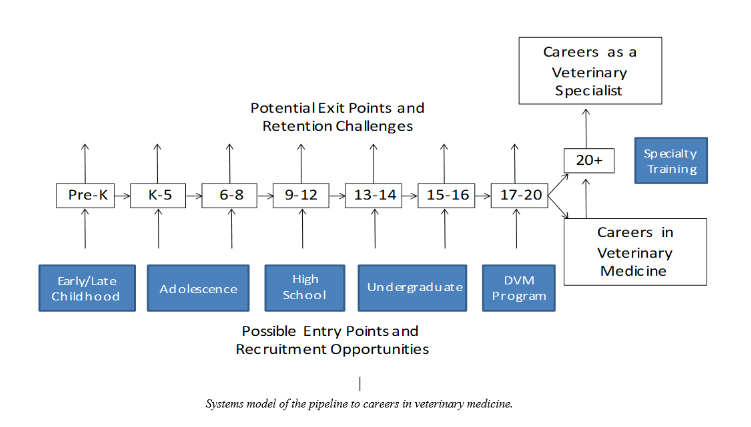
Interest in Veterinary medicine typically forms early in life—often during adolescence—and students who commit late to the field are more likely to come from successful, deliberate recruiting efforts. This points to the value of engaging students well before college. The figure below, adapted from earlier published work, illustrates the full pipeline of entry points and potential exit points from early childhood through specialty training.
Bottom Line
The Veterinary medical applicant pool remains healthy today, but its future size is genuinely uncertain; the trends that produced strong growth over the past decade may not continue automatically. As enrollment expansion continues, deliberate, well-funded, and pipeline-wide recruitment—starting long before students reach college—will be essential to ensuring an adequate pool of qualified applicants for the growing number of available seats.
Source and Further Reading
This column is based on: Lloyd JW, Greenhill LM. The American Association of Veterinary Medical Colleges Applicant Pool: Analysis of Critical Undergraduate Enrollment Trends. J Vet Med Educ. 2026. doi:10.3138/jvme-2025-0107.
Additional sources referenced in the original article include:
- Gitter RJ, LaFayette B. Demand for and Supply of Veterinarians in the U.S. to 2032. AAVMC; 2024.
- Lloyd JW. Evaluating the Depth of Quality in the 2018 AAVMC Applicant Pool. Association of American Veterinary Medical Colleges; 2019.
- Lane P, Falkenstern C, Bransberger P. Knocking at the College Door—Projections of High School Graduates. Western Interstate Commission for Higher Education; 2024.
- Jones JM. U.S. Confidence in Higher Education Now Closely Divided. Gallup; 2024.
- Lloyd JW. Here Be Dragons: Barriers to and Opportunities for Change. In: Navigating Diversity and Inclusion in Veterinary Medicine. Purdue University Press; 2013 (source of Systems Model Figure).